
Water removal and drying in Fort Worth, TX
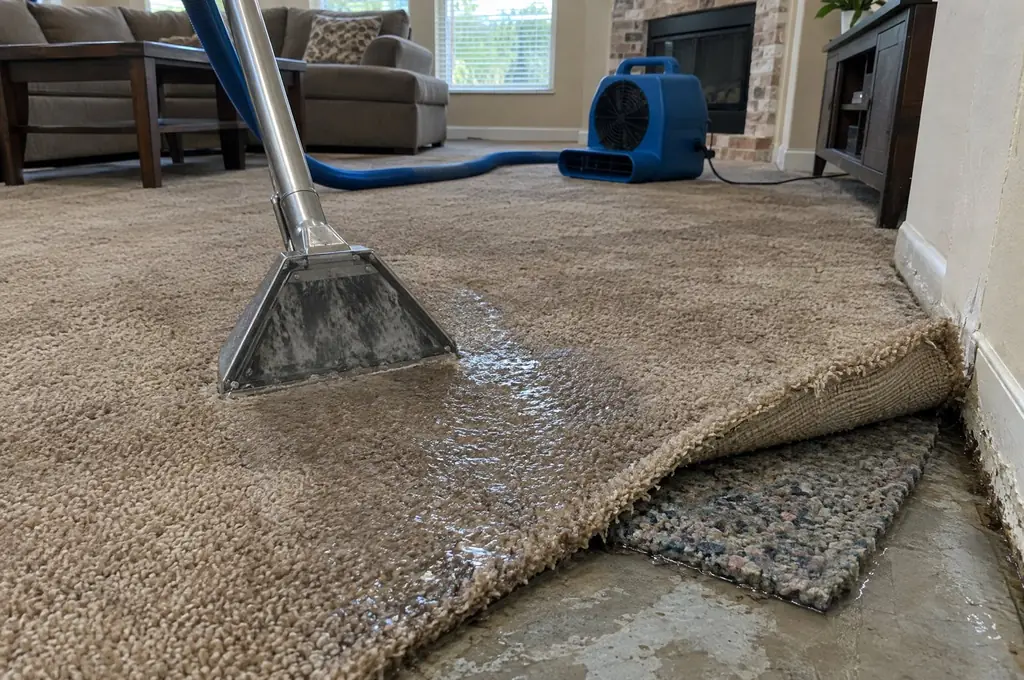
Water removal in Fort Worth means extracting standing water from carpet, pad and hard floors, then drying the slab, walls and cabinets with air movers and dehumidifiers until moisture readings are normal. TDI's advice is to start right away, because mold can begin growing within a day after a leak.
Your call is connected with an independent local water damage company, chosen by a call network; ask what it handles before work starts. Water category: category 1 (clean water) when it comes from a supply line and is caught quickly.
Fort Worth's long, humid summers matter here. Outside air is often wetter than the air in the house, so drying usually means keeping windows shut and letting the AC and dehumidifiers pull the moisture out.
Right now
- 1Shut the valve at the appliance or toilet, or the house valve.
- 2Soak up what you can with towels and a wet vacuum on hard floors.
- 3Pull up area rugs and move furniture off wet carpet, with foil or blocks under the legs of anything heavy.
- 4Keep windows closed in humid weather and run the AC.
- 5Take dated photos of the source and the wet areas for your own records.
Fort Worth and Texas facts for this problem
TDI's advice after a leak is to stop the water, remove standing water and start drying right away, because mold can start within a day.
Source: When are water damage and mold covered by insurance? (Texas Department of Insurance).
EPA guidance: get water-damaged areas and belongings dry within 24 to 48 hours so mold doesn't take hold.
Source: A Brief Guide to Mold, Moisture and Your Home (EPA).
The IICRC airmover worksheet calls for one air mover per affected room, then one more for each 50 to 70 square feet of wet floor, rounding fractions up.
Source: IICRC Airmover and Gallons Calculation Worksheet (rev. 7.1.22).
Fort Worth's normal year brings 37.01 in. of rain in the official record, with May the wettest month at 4.78 in. (1991-2020 normals).
Source: ACIS daily record, official Dallas/Fort Worth climate record, calculated by Fort Worth Water Damage & Mold on November 18, 2026.
The wettest calendar year in the record since 1898 is 2015, with 62.61 in of rain.
Source: ACIS daily record, official Dallas/Fort Worth climate record, calculated by Fort Worth Water Damage & Mold on November 18, 2026.
Only about 0.6% of homes in these Fort Worth ZIPs had a residential NFIP flood policy in force on September 1, 2026.
Source: FEMA OpenFEMA NFIP Redacted Policies v3, calculated by Fort Worth Water Damage & Mold on November 13, 2026.
TDI's advice after a leak is to stop the water, remove standing water and start drying right away, because mold can begin growing within a day. Pulling up wet carpet and moving wet items to a dry, airy room are on its list.
Sources: When are water damage and mold covered by insurance? (Texas Department of Insurance)
Related on this site: the Fort Worth weather page for whether the outdoor air is drier than inside today, and the water damage estimator for the drying gear a job your size usually needs.
How the work usually goes
1.Inspection
Meters and a thermal camera map where the water went, including under cabinets and behind baseboards.
You: Point out where you first saw the water and when.
2.Extraction
Truck-mounted or portable extractors pull water out of carpet and pad so the drying gear can work.
You: Clear a path to the wet rooms.
3.Setup
Air movers follow the IICRC worksheet: one per affected room plus one for every 50 to 70 square feet of wet floor. Dehumidifiers are sized from room volume.
You: Leave the equipment on day and night.
4.Daily checks
Readings are taken each day and equipment is moved as areas dry.
You: Ask for the readings in writing.
5.Sign-off
Drying ends when materials reach their dry readings, not on a set day.
You: Keep the readings with your records.
How insurance usually treats it
TDI lists a burst washer hose and a toilet overflow among the sudden, accidental water damage most Texas home and renters policies cover. The appliance or valve that failed is usually a separate repair, and damage from a slow drip that went on for weeks is usually excluded.
General information, not insurance advice; the policy itself decides. More on the Fort Worth water damage insurance page.
What changes the size of the job
- Square footage and number of rooms that got wet
- Carpet, laminate, wood or tile
- Whether water got under cabinets or into walls
- How long it sat before extraction
- Days of drying, and the count of air movers and dehumidifiers
No prices on this site. A company measures moisture on site and writes an itemized estimate; the water damage estimator lists what that estimate should include.
Questions people ask about water removal and drying
How long does it take to dry a house after a leak?
Drying ends when the moisture readings are normal, not on a set day. Carpet and drywall dry faster than a concrete slab, wood floors or cabinets.
Should I open the windows to dry out a wet room in Fort Worth?
Only when the outside air is drier than the air in the wet room, which a lower outdoor dew point shows. In much of the Fort Worth year it isn't, so keeping the house shut with the AC running usually dries it faster.
How many air movers does a water damage job need?
The IICRC worksheet calls for one air mover per affected room plus one for every 50 to 70 square feet of wet floor. The estimator on this site works out that range from your answers.