
Mold remediation in Fort Worth, TX
Mold remediation in Fort Worth means fixing the moisture that fed the mold, closing off the area, taking out what can't be cleaned and drying the rest. Texas adds two rules: from 25 contiguous square feet the remediator needs a TDLR license, and a separate licensed assessor writes the plan before work starts.
Your call is connected with an independent local water damage company, chosen by a call network; ask what it handles before work starts. Water category: depends on the water that fed it; mold from sewage or flood water starts out as category 3.
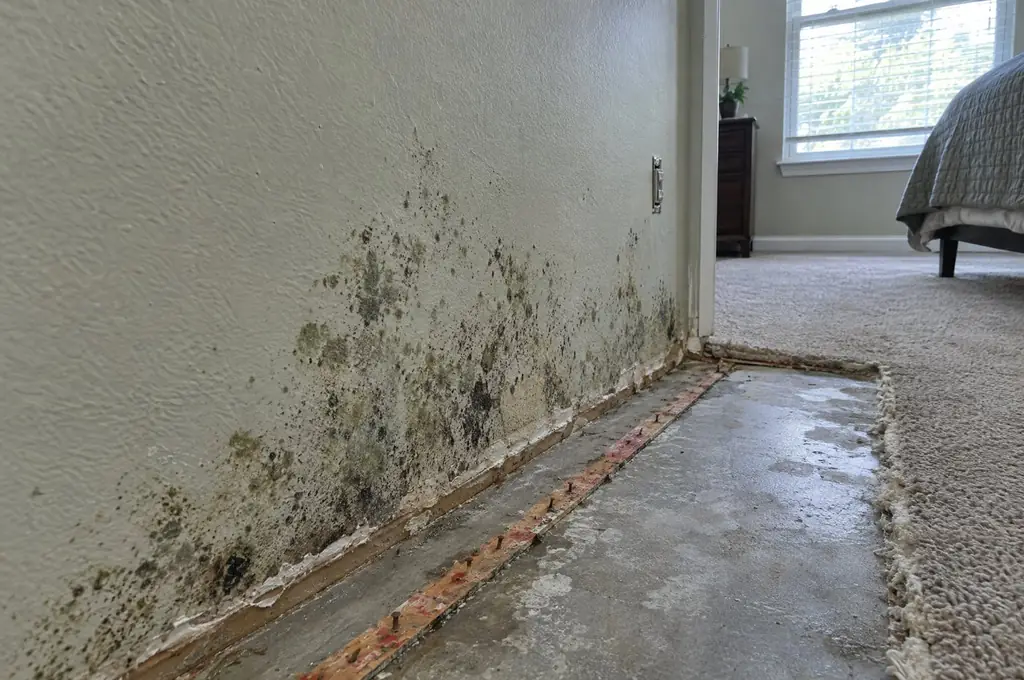
Look where water could sit without anyone seeing it: behind the baseboards along a slab that has been leaking, above a ceiling under the attic air handler, or under carpet pad near a sliding door. What shows on the surface is usually smaller than what is behind it.
Right now
- 1Stop the moisture if you can: shut the supply valve, put a bucket under a drip, switch off an AC that is spilling into the ceiling.
- 2Leave a large patch alone. Scrubbing or dry-brushing it sends spores through the house.
- 3If the mold is near an AC return or a supply vent, keep the system fan off until someone checks it.
- 4Take dated photos and a short video for your own records before anything is moved.
- 5Keep the AC running on cool in the rest of the house so indoor humidity stays down.
Fort Worth and Texas facts for this problem
Texas requires a TDLR mold remediation license once mold covers 25 contiguous square feet or more; below that, an owner or tenant may do the work on their own home without one.
Source: Texas Occupations Code chapter 1958 (mold assessors and remediators).
On the same project, Texas bars one license holder from doing both the mold assessment and the remediation, and bars one person from owning both companies.
Source: Texas Occupations Code chapter 1958 (mold assessors and remediators).
Within 10 days of finishing, the remediator must give the owner a certificate of mold remediation, and Texas sellers hand buyers copies of certificates from the last five years.
Source: Texas Occupations Code chapter 1958 (mold assessors and remediators).
TDI says most home policies don't cover mold from gradual leaks or seepage, and that mold can start growing within a day after a leak.
Source: When are water damage and mold covered by insurance? (Texas Department of Insurance).
The Texas FAIR Plan, the insurer for people turned down elsewhere, was set up in December 2002 partly because of growing mold and water damage claims; it had 3,313 policies in force in Tarrant County on June 30, 2026.
Source: TDI: Texas FAIR Plan Association Overview (Oct. 1, 2026).
About 39% of the homes in the 26 ZIP codes mostly inside Fort Worth city limits were built before 1980, according to Census estimates for ACS 5-year 2020-2024.
Source: U.S. Census Bureau, ACS 5-year, tables B25034 and B25035, calculated by Fort Worth Water Damage & Mold on November 13, 2026.
Texas licenses mold work. At 25 contiguous square feet or more the remediator needs a TDLR license, a different licensed assessor writes the protocol, and the remediator owes you a certificate within 10 days of finishing. TDLR's license search shows whether a company holds one.
Sources: Texas Occupations Code chapter 1958 (mold assessors and remediators); TDLR license search
Related on this site: the Fort Worth rain totals and humidity page for today's dew point at Meacham Field, and the flood map by ZIP for how old the homes are in each Fort Worth ZIP.
How the work usually goes
1.Assessment and plan
For 25 contiguous square feet or more, a TDLR-licensed mold assessor inspects, may take samples and writes the remediation protocol. In Texas that assessor can't be the company that removes the mold.
You: Ask both companies for their TDLR license numbers and look them up before anyone opens a wall.
2.Containment
Plastic sheeting seals the work area and a HEPA air scrubber keeps loose spores from drifting into the rest of the house.
You: Keep children, pets and anyone with asthma out of the sealed area.
3.Removal and cleaning
Moldy drywall, insulation, carpet pad and baseboards usually come out. Framing and the concrete slab are cleaned and HEPA-vacuumed instead.
You: Ask which materials will be removed and why, in writing.
4.Drying and the cause
The leak, AC drain or seepage behind the mold gets fixed, and the area is dried until moisture readings return to normal.
You: Ask for the moisture readings from each visit.
5.Clearance and certificate
The assessor checks the finished area. Within 10 days the remediator owes you a certificate of mold remediation.
You: Keep the certificate. Texas sellers give buyers copies from the last five years.
How insurance usually treats it
TDI says mold that grows on an item damaged by a covered, sudden water loss is covered, but most home policies leave out mold from gradual leaks or seepage, and most don't pay for cleanup and testing once the damaged item is gone. Some insurers sell an add-on for mold cleanup after a covered loss; the declarations page shows whether a policy has one.
General information, not insurance advice; the policy itself decides. More on the Fort Worth water damage insurance page.
What changes the size of the job
- How many square feet are affected, including what is hidden behind walls and baseboards
- Whether the job crosses 25 contiguous square feet, which brings in a licensed assessor and remediator
- Plastic containment and air scrubbers to keep spores out of the rest of the house
- Whether the AC air handler, ductwork or attic is involved
- What has to be replaced afterward, which is often a separate estimate
No prices on this site. A company measures moisture on site and writes an itemized estimate; the water damage estimator lists what that estimate should include.
Questions people ask about mold remediation
Does Texas require a license for mold remediation in Fort Worth?
Yes, once mold covers 25 contiguous square feet or more. The remediator needs a TDLR mold remediation license, and a separately licensed assessor writes the plan. A homeowner working on their own house under that size needs no license.
Why can't the company that tested the mold also remove it?
Texas Occupations Code section 1958.155 bars one license holder from doing both on the same project, and bars one person from owning both firms on that job, so the company judging how much needs removing doesn't profit from removing it.
Can attic AC ducts spread mold through a Fort Worth house?
A moldy air handler or duct can blow spores into other rooms. The EPA says to have the system checked before running it if you suspect mold inside, and to keep drip pans clean and drain lines flowing.
How fast does mold start after a leak?
TDI says mold can start growing within a day after a leak, and the EPA's guidance is to get wet materials dry within 24 to 48 hours.
Sources for this page
- Texas Occupations Code chapter 1958 (mold assessors and remediators)
- TDLR license search
- When are water damage and mold covered by insurance? (Texas Department of Insurance)
- TDI: Texas FAIR Plan Association Overview (Oct. 1, 2026)
- A Brief Guide to Mold, Moisture and Your Home (EPA)
- EPA: Mold Cleanup in Your Home